Island Soul
Ley lines and earth energies of the Isle of Man


The Benker grid is a 10 x 10m (about 30 x 30 ft) earth grid named after Anton Benker, a German dowser from Bavaria. The distance between grid lines is around 10m, the lines themselves having a thickness of around 20-30cm. It is exactly congruent with the Hartmann Grid and may be a higher resonance of same. It is sometimes called the Benker Cubical Grid because it has three-dimensional symmetry. Dimensions and intensities can vary dependent on geographic latitude and the specific location.
The Benker grid tends to have more of an electromagnetic nature than the other grids and some people are more sensitive to it than others.
(Source: British Dowsing, britishdowsing.net)
A vertical shaft of ascending water that does not rise to the surface of the earth but disperses through several horizontal fissures which can be at various depths. Dowsers identify blind springs as several underground streams radiating from a central point. Some of these may subdivide into smaller streams.
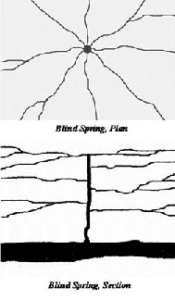
Blind springs are found under many ancient sites and churches but are also to be found elsewhere throughout the countryside. There is an associated energy field that is unique to a blind spring as well as
the water component. The Blind Spring will have a feeder stream at a greater depth. It is thought that the water is forced to rise up the vertical fissure due to a narrowing of the feeder stream.
Often referred to as a Water Dome in North America.
(Source: British Dowsing, britishdowsing.net)
Curry Grids are diagonal grid systems and have “windows” of about 3.5 x 3.5m. Intersections can be polarised positive, negative or neutral.
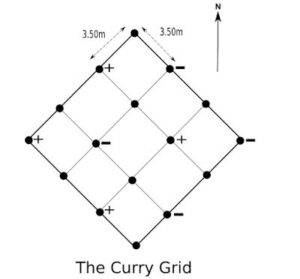
The Curry grid is an earth grid named after the German doctor Dr Manfred Curry who was the founder of the Bioclimatic Institute in Bavaria. It is thought to be more biologically damaging than the Hartmann, especially the double lines that occur at approximately every 50 metres. The distance of the grid line spacing’s vary according to location and can vary from 2.5 x 3.5 m. In England they are approximately at 2.36 x 2.7 m.
Curry grid is associated with Neptune energies.
(Source: British Dowsing, britishdowsing.net)
Lines of dowsable energy which generally run straight, are 2-3m (6-9ft) wide at their central core (but can be much wider), and often have further bands or edges to either side. Influenced both in width and strength by lunar and solar cycles. They are often found at what are called sacred sites, but may also be encountered independently. They usually start or terminate at a Power Centre.
Whilst energy leys are considered to be natural energy phenomena it is also thought that they can be created by the formation of structures and in some cases have been observed to appear after a structure is built and are drawn to the site as the result of human activity of a spiritual nature.
Researcher R Duff theorises that some energy leys are formed by ultra-low frequency sonic resonances created by the rotation of the Earth’s iron core, and has classified several distinct types of lines. However, as not every dowser finds the same results this viewpoint is not universally accepted.
Energy Ley lines are associated with carrying energy/life force from the sun.
(Source: British Dowsing, britishdowsing.net)
The direction energy takes when moving. It may be straight or curved, in several dimensions and be composed of one or more different types of energies, i.e. negative, positive or neutral. Energy lines can be found at standing stones and ancient sites but are a general feature in all energy fields.
(Source: British Dowsing, britishdowsing.net)
Geopathic stress is a name for the energies that can harm the health of humans. Geopathic stress is a distorted or disrupted electromagnetic field of the Earth (Schumann Resonance / Waves). The Earth resonates with an electromagnetic frequency of approximately 7.83 Hz – Schumann resonances (SR), which falls within the range of (alpha) human brainwaves.
Underground streams, sewers, water pipes, electricity, tunnels and underground railways, mineral formations and geological faults distort the natural resonance of the Earth thus creating geopathic stress (GS).
Sleeping or spending a lot of time in geopathic stress zones can cause detrimental effects on our health, performance and wellbeing.
Our ancestors knew about geopathic stress or geopathic zones. In feng shui, Chinese called geopathic stress as ‘claws of the dragon’ or ‘dragon lines’ or ‘underground demons’. Ancient Romans would test areas for new buildings by allowing sheep to graze in the potential area for a year and then they would dissect the sheep to see if their organs were healthy or not (Roman architect Vitruvius was aware of GS). Hippocrates and Avicenna (Islamic scholar) talked about the importance of location of buildings in relation to health. Bavarians would install anthills in prospective bedrooms to see if the ants like the place or not (ants will not live in areas of geopathic stress). One German researcher, Baron Gustav Freiherr von Pohl, (who coined the term geopathic zones), after an extensive study, came to the conclusion that every single disease could be linked to geopathic stress
Hartman Grids are horizontal grid systems and have “windows” of about 2 x 2.5m with a 20cm space between them. Intersections can be polarised positive, neutral or negative.
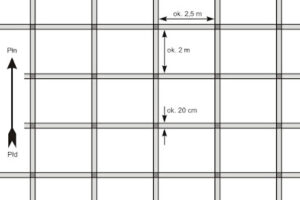
The Hartmann grid is an earth grid named after Dr Ernst Hartmann who it is thought was the first to observe earth grids. It is a worldwide grid in accordance with the earth’s magnetic field, i.e. approximately N/S, E/W.
There are considerable variations in the grid spacing dependent on local conditions and the degree of latitude. In Greenland a spacing of 1.05m x 1.20m is found. In England the average spacing is 1.60m x 1.68m while in the Canary Islands it is 2.00m x 2.50m. The straightness and orientation of the grid lines can be affected by building geometry, high voltage power lines and radio stations etc.
Hartman grid runs north to south, east to west and is associated with Moon energies.
(Source: British Dowsing, britishdowsing.net)
A significant alignment of sacred and secular sites across a landscape, generally inter-visible. The minimum number of aligned sites to qualify as a ley is five. The term was first used by Alfred Watkins in 1921. Watkins never used the term ‘ley line’.
There is no associated energy line indicated by the term ‘ley’ as Watkins described it, and therefore it is not to be confused with an Energy Ley.
(Source: British Dowsing, britishdowsing.net)
The term used (incorrectly) by many dowsers to describe an energy ley, a straight line of energy that may link ancient sites where it coincides with a visual ley. It is easily confused with the term ley, which is a purely visual alignment, and therefore its use is not recommended by dowsers. It is also commonly used indiscriminately by the public in general. Alfred Watkins never used the term ‘ley line’.
Ley Lines is old English for walking path are thought to be human-made energy lines. Major local ley lines (paths) were turned into causeways and highways over time. You would connect local monuments, churches, frequented places and connect those lines.
The existence of alignments between sites is easily demonstrated. However, the causes of these alignments are disputed. There are several major areas of interpretation:
Archaeological: A new area of archaeological study, archaeogeodesy, examines geodesy as practiced in prehistoric time, and as evidenced by archaeological remains. One major aspect of modern geodesy is surveying. As interpreted by geodesy, the so-called ley lines can be the product of ancient surveying, property markings, or commonly travelled pathways. Numerous societies, ancient and modern, employ straight lines between points of use; archaeologists have documented these traditions. Modern surveying also results in placement of constructs in lines on the landscape. It is reasonable to expect human constructs and activity areas to reflect human use of lines.
Cultural: Many cultures use straight lines across the landscape. In South America, such lines often are directed towards mountain peaks; the Nazca lines are a famous example of lengthy lines made by ancient cultures. Huacas are strengthened when people walk along the lines connecting the huaca with their community. Straight lines connect ancient pyramids in Mexico. Today, modern roads built over the ancient lines cause a break in the ley line. The Chaco culture of Northeastern New Mexico cut stairs into sandstone cliffs to facilitate keeping their ley lines straight. The Rosslyn chapel is said to have many ley lines connected to it. Spiral symbols were often carved in rocks where these problematic energies required controlling. Examples of these can be seen in stone from Chaco canyon to, New Grange Ireland, to White Spring in Glastonbury, England. These were also known by Natives as the "web of life". What you do to the "web of life" you do to yourself, as we are connected. If Earth is out of balance the whole solar system can be affected.
The existence of alignments between sites is easily demonstrated. It operates through geometrical patterns that follow a specific symmetry linked to sacred geometry.
a) A node is found at the intersection of two or more energy lines, particularly serpent lines/ dragon currents, giving a highly charged point of energy, often associated with a power centre. Usually the lines will narrow to a point at the node.
b) Seven nodes are to be found on most ancient standing stones. Five are above ground level and two are on the section of the stone below ground level. They are likened to the seven major chakras of the human body. Nodes can be found at many places other than standing stones.
(Source: British Dowsing, britishdowsing.net)
A place where there is an intensity of beneficial energy and a meeting point of yang and yin earth energies. Power centres are associated with blind springs that have at least one energy ley crossing them and are found at most ancient sacred sites, frequently accompanied by radials and/or a geospiral. However, they can also be found elsewhere. Power centres are generally considered to be places suitable for spiritual enlightenment and healing. Dowsers using a sleeved L-rod have noted that when directly over a power centre the rod will rotate through 360 degrees.
(Source: British Dowsing, britishdowsing.net)
Pyres grid runs north to south and is associated with Pluto energies.
Schneider grid is associated with Mars energy.
Schumann resonances are extremely low-frequency (ELF) global electromagnetic resonances, excited by lightning discharges in the cavity formed between the Earth’s surface and the ionosphere.
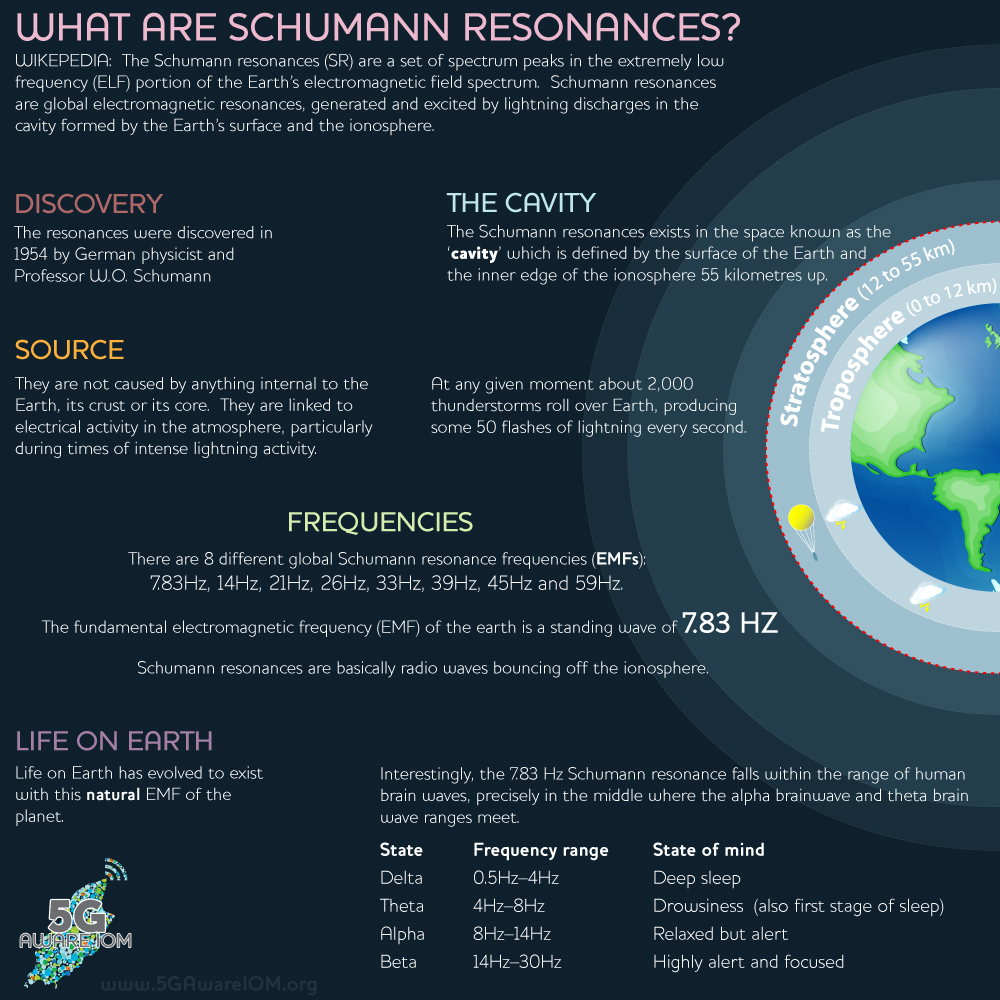
The base frequency is around 7.83 Hz but there are several higher harmonics. As the range of frequencies is largely congruent with human brain waves, it is thought that disturbances of the Schumann Resonances may be a component in Geopathic Stress. Several commercial GS-reducing devices are based upon Schumann wave generation.
Lines of energy found on the surface of the earth by dowsers, and are unlike energy leys in that they do not run straight. They can be of any length from a few feet to many miles.
The term was coined by Hamish Miller and Paul Broadhurst. The Michael and Mary lines, which cross England from Cornwall to the East coast of Norfolk, are described in their book ‘The Sun and the Serpent’, and the Apollo and Athena lines that cross Europe are described in their book ‘The Dance of The Dragon’.
Other pairs of lines have been found, such as Bel and Elen associated with the Belinus Line, documented by Gary Biltcliffe and Caroline Hoare in ‘The Spine of Albion‘.
There is a tendency nowadays to refer to these long-distance polarised pairs as Dragon Lines.
(Source: British Dowsing, britishdowsing.net)
Telluric currents (another name for Earth Energies) flow in the surface layers of the earth. The electric potential on the Earth's surface can be measured at different points, enabling the calculation of the magnitudes and directions of the telluric currents and hence the Earth's conductance.
a) The form that energy can take when either ascending or descending vertically. Usually found in groups of up to seven terminating in a toroid, joined either point to point or base to base. In some cases, at these junctions the flow of the energy can change from clockwise to anticlockwise or vice-versa. Change in polarity from negative to positive can also occur. Vortices are a common feature where energy lines intersect. Rising vortices are commonly found over blind springs, descending vortices are found where two water veins cross.
b) Also used (mainly in North America) to refer to areas where various magnetic and gravitational anomalies may be detected, often accompanied by time and space distortions. The area of influence of such vortices is said to be 54 miles in diameter and connects into larger earth grid patterns.
(Source: British Dowsing, britishdowsing.net)
Wittmann grid is diagonal and is associated with Venus energies.
A term used by practitioners of eastern medicine and although not exactly similar is used by many western dowsers as an alternative term for /positive-polarity energy. Yang energy is considered to be masculine and active.
A term used by practitioners of eastern medicine and although not exactly similar is used by many western dowsers as an alternative term for negative-polarity energy. Yin energy is considered to be feminine and receptive.